

Owner-building removes a builder's margin, not the work it paid for. Here is the budget structure, the statutory costs by state, and how to price the rest.
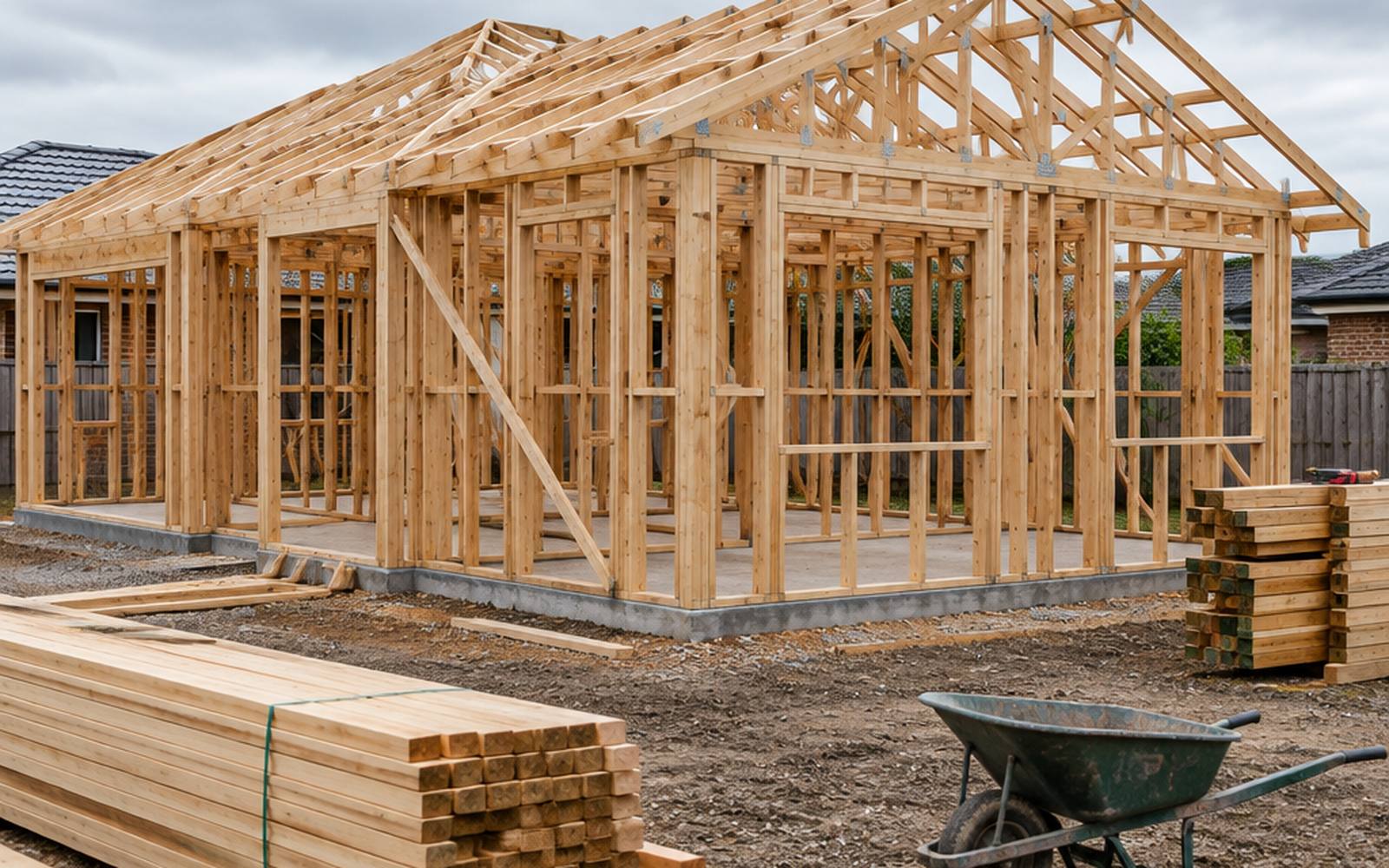
There is no single owner-builder cost figure that means anything, because the number is set by your plans, your site and your finishes. A usable budget is built by pricing your own scope line by line, not by applying someone else’s average.
Permits, approvals, inspections and certification are set by the regulator or the certifier, and any cover your state requires is priced by the insurer. They are small against the build, but they are the costs that stop the job if they are missing.
Trades, materials and site works take the bulk of the budget, and they are the lines you can actually influence: by designing to the site, quoting the same scope three ways, and holding a contingency you do not spend early.
This guide covers New South Wales, Queensland and Western Australia, the three states where our readers build, and it deliberately quotes no build-cost figures. Rates move, and a number copied from another project is the fastest way to under-budget your own. What follows is the structure of an owner-builder budget, the statutory costs that are fixed by the regulator, and a method for pricing the rest yourself.
In short
- A budget is seven cost lines, not one total: site works, design and approvals, statutory permits, insurance, trades and materials, contingency, and finance or holding costs.
- The statutory lines are set by your state and your certifier. They are unavoidable, and in NSW the application asks for your estimated cost of labour and materials.
- Most of the money sits in trades and materials, so that is where the estimating effort belongs: same scope, three written quotes, inclusions compared line by line.
- Hold a contingency and keep it unspent until a real variation or an unpriced site condition appears, because those two are what break owner-builder budgets.
What an owner-builder budget actually has to cover
Owner-building removes a builder’s margin and supervision fee from the project, but it does not remove the work those fees paid for. The coordination, the sequencing, the compliance and the risk all move to you, and each of them carries a cost that has to appear in the budget rather than surprise you in month four.
Seven lines cover a residential project. Price them separately, because a single lump sum hides the one you have forgotten.
- Site works and preparation. Clearing, excavation, earthworks, retaining, drainage, driveways, service connections and any make-good to existing structures. This is the line most often under-priced, because it is the line you cannot see on the plans.
- Design and documentation. Drafting or architectural fees, structural and hydraulic engineering, surveys, geotechnical reports, energy reports and any consultant your council or certifier asks for.
- Statutory permits and approvals. The owner-builder permit or approval in your state, the development consent or complying development certificate where one is required, the construction certificate and the building permit, plus inspection and certification fees.
- Insurance. Whatever cover your state requires for the work, plus contract works and public liability cover for the site while you are running it.
- Trades and materials. The bulk of the budget. Every licensed trade, every supplier, every fixture, and the hire equipment you need between trades.
- Contingency. A reserve for what the site or the design has not yet revealed. It is not a slush fund and it is not part of your finishes allowance.
- Finance and holding costs. Interest, loan establishment and draw fees, rent or the mortgage you carry while the build runs, and the cost of any delay in a progress draw.
The statutory costs, state by state
These are the costs you cannot quote down. Each state sets its own trigger, its own application process and its own fees, and the trigger is measured on the value of the work rather than on what you spend out of your own pocket.
| What you are checking | New South Wales | Queensland | Western Australia |
|---|---|---|---|
| When the permit or approval applies | Work worth more than $10,000 on a dwelling, measured on the reasonable market cost including labour and materials, where you are not contracting a licensed builder to supervise and the work needs development consent or is complying development | A building project valued at more than $11,000 including GST, on your own land, company-owned land where you are a director, or leased land with the owner’s written permission | Where a building permit is required and the estimated value of the building work exceeds $20,000, or $50,000 for a Class 10a building such as a shed, carport or private garage |
| Education or course component | The owner-builder approved education requirements, or other equivalent accreditation, where the cost of the building work is $20,000 or more | Unless you qualify for an exemption you must complete the Owner-builder course, and it must be finished in the last five years; in some instances an asbestos awareness training course is also required | Sufficient knowledge, shown by one of: completing an appropriate owner-builder course; holding current or previous Building Practitioners registration in WA; being registered as an architect, building surveyor or building engineer in WA; or completing owner-builder training with Western Australian specific content within the previous 24 months |
| Fees and how you lodge | The application is lodged online or in person with your payment, and is assessed by Building Commission NSW against set criteria | The online Owner-builder permit application lets you complete, pay for and submit in a single transaction, and the application fee does not include course costs | Fees are set out on the department’s fees page, and the approval is applied for separately from the building permit |
The NSW application is where your own estimate becomes a document. Service NSW lists the estimated cost of the building work for labour and materials among the documents you provide, alongside proof of ownership, the plans that accompany your development approval or complying development certificate, your white card and your education evidence. Building Commission NSW assesses the application on qualifications, experience, skills and knowledge where required, and fitness and propriety.
Queensland adds three things worth knowing before you price anything. The permit applies to projects valued at more than $11,000 including GST, and for farm buildings the value of work can be up to $27,500. And the course is a separate cost: unless an exemption applies you must complete the Owner-builder course, finished within the last five years, and the QBCC states that the permit application fee does not include course costs.
Western Australia is the clearest example of why insurance belongs in the budget as a line rather than an afterthought. The state requires home indemnity insurance on all residential building work valued over $20,000, except for a Class 10 building, where the figure is $50,000, and the cover is not required for associated work such as building only a pergola, fence or swimming pool. If you sell the home within seven years from the date a building permit is issued, the Home Building Contracts Act 1991 requires you to have a policy in place that covers subsequent owners for the remainder of that seven-year period, and selling within that window without cover is an offence carrying a penalty of $10,000.
One rule shapes every budget in Western Australia: you may not split building work into separate projects, each valued below $20,000, or $50,000 for Class 10a buildings, to avoid occupational licensing. If your project is close to a threshold, price it whole rather than in stages designed to sit under the line.
What moves the number most
Two projects with the same floor area can differ substantially in cost, and the difference is almost never the house itself. It is the ground under it and the decisions around it.
The site. Slope drives excavation, retaining and drainage. Soil classification drives footings. Tight access drives crane hire, pump hire and the labour hours lost carrying materials by hand. A site with services that are not where the plan says they are drives the first variation.
The overlays. Bushfire, flood, heritage and easements all change what can be built and how. Each one is a design constraint that carries a construction cost, and each one is cheaper to discover before the drawings are finished than after the slab is poured.
The design. Complexity costs more than size. Cantilevers, long spans, curved walls, wet areas that sit away from the plumbing stack and roofs with many planes all add labour and engineering. A simpler plan on the same footprint usually costs less to build and less to certify.
The finishes and the fixtures. This is the line you control directly, and the one where a selection made late becomes a variation. Choose before the trade prices the work, not after.
The programme. Every week of delay costs money in interest, rent or holding costs, and trades that are booked solid charge for the certainty you are asking them to give up. A realistic programme is a budget item, not an administrative one.
The unknowns. Asbestos in an existing structure, rock in the excavation, a water tank under the slab, a sewer line that needs to be relocated. None of these are exotic, and all of them are why the contingency exists.
How to build the estimate before you commit
An owner-builder estimate is a document you assemble, not a figure you look up. Do it in this order and the total you reach will be one you can defend to a lender, a certifier and yourself.
- Finish the drawings and the engineering first. You cannot price what is not drawn. Every consultant report you commission now is cheaper than the variation it prevents later.
- Write a quantity list by trade. Break the project into the trades that will actually quote it: excavation, concrete, framing, roofing, plumbing, electrical, glazing, plastering, joinery, tiling, painting, landscaping.
- Get three written quotes per trade on the same scope. Same drawings, same inclusions, same exclusions, same timeframe. A quote you cannot compare line by line is not a quote, it is an opening position.
- Separate the allowances from the fixed prices. Provisional sums and prime cost items are placeholders. Record each allowance and what it buys, so the day the real cost arrives you know which line moved.
- Add the statutory lines from your state’s pages. Permit or approval, consents, certification, inspections and any insurance your state requires. Use the regulator’s own pages rather than a forum.
- Set the contingency and protect it. Size it against the unknowns you listed for your site, and treat it as untouchable until one of them actually appears.
- Build a cash flow by stage and match it to your finance. Know which draw pays which trade, and how many weeks you can carry a delay before the interest bill changes your finishes.
Then keep the estimate alive. Every variation gets a written price and a written approval before the work proceeds, and every trade invoice gets checked against the quote it came from. The owner-builders who finish close to budget are not the ones who estimated best at the start; they are the ones who refused to let an unpriced instruction onto the site.
FAQs
How much does it cost to build a house as an owner builder?
There is no figure that transfers from one project to another, because the cost is set by your site, your drawings, your finishes and your state’s requirements. What does transfer is the structure: site works, design and documentation, statutory permits, insurance, trades and materials, contingency, and finance or holding costs. Price each line from your own quotes and you have a number that means something for your project.
Do owner builders actually save money?
You avoid paying a builder’s margin and supervision fee, and in exchange you take on the coordination, the sequencing, the compliance and the risk those fees covered. Whether that leaves you ahead depends on how well you price the work, how many variations you avoid, and whether your own time on the project has a cost you are counting. A budget that leaves out the contingency or the holding costs will look like a saving that is not there.
What does the owner-builder permit cost in each state?
The permit or approval carries a fee set by the regulator in each state, and it is payable with the application rather than at completion. In NSW the application is lodged online or in person with your payment and assessed by Building Commission NSW; in Queensland the online Owner-builder permit application lets you complete, pay for and submit in a single transaction; in WA the fees are set out on the department’s fees page. Check the current fee on the regulator’s page before you finalise the budget, because fees are indexed and change.
Is insurance a separate line in an owner-builder budget?
Yes, and in Western Australia the trigger is explicit: home indemnity insurance is required for residential building work valued over $20,000, or $50,000 for a Class 10 building, and it is not required for associated work such as building only a pergola, fence or swimming pool. NSW and Queensland each run their own scheme for cover on residential work, so check the trigger on the relevant regulator’s page before you set the allowance rather than assuming another state’s rule applies.
Can I split my project into stages to stay under a threshold?
Not in Western Australia. The state’s owner-builder page states that you may not split building work into separate projects, each valued below $20,000, or $50,000 for Class 10a buildings, to avoid occupational licensing. If your project is near a threshold, price and permit it as one project.
What size contingency should an owner builder hold?
There is no single percentage that fits every project, so size it against the unknowns you can actually name: soil and footings, services you cannot see, an existing structure you are building against, and any design decision still open when the trades quote. Price those items as far as you can, add a reserve for the ones you cannot, and keep the reserve untouched until one of them appears. A contingency spent on finishes is not a contingency.
What is the most common reason an owner-builder budget blows out?
Variations and unpriced site conditions, in that order. A variation happens when a decision is made after the trade has priced the work, and a site condition becomes a variation when nobody priced it at all. Written quotes on a fixed scope, selections made before pricing, and a protected contingency are what keep both in check.
Do I need to give the regulator my estimated building cost?
In NSW, yes. Service NSW lists the estimated cost of the building work for labour and materials among the documents you provide with an owner-builder permit application, alongside proof of ownership, your development approval or complying development certificate, your white card and your education evidence. The threshold itself is measured on the reasonable market cost including labour and materials, not on what you actually pay.
Sources checked
- Service NSW, Apply for an Owner-Builder Permit (read 25 Nov 2026): service.nsw.gov.au
- Queensland Building and Construction Commission, Apply for an Owner-builder permit (read 25 Nov 2026): qbcc.qld.gov.au
- Queensland Building and Construction Commission, Required courses for Owner-builders (read 25 Nov 2026): qbcc.qld.gov.au
- Government of Western Australia, Owner-builder approval (read 25 Nov 2026): wa.gov.au
Ready to Start Your Owner Builder Journey?
Complete your Owner Builder Course online with Owner Builder Centre (RTO 91528). Approved courses for NSW, QLD & WA. Fast certification, enrol today.